
When I first watched Fingersmith, I thought I was getting a restrained Victorian lesbian romance — elegant, distant, emotionally coded.
What I actually experienced was something far more unsettling: a story about how women survive inside systems that are specifically designed to dispossess, silence, and confine them.
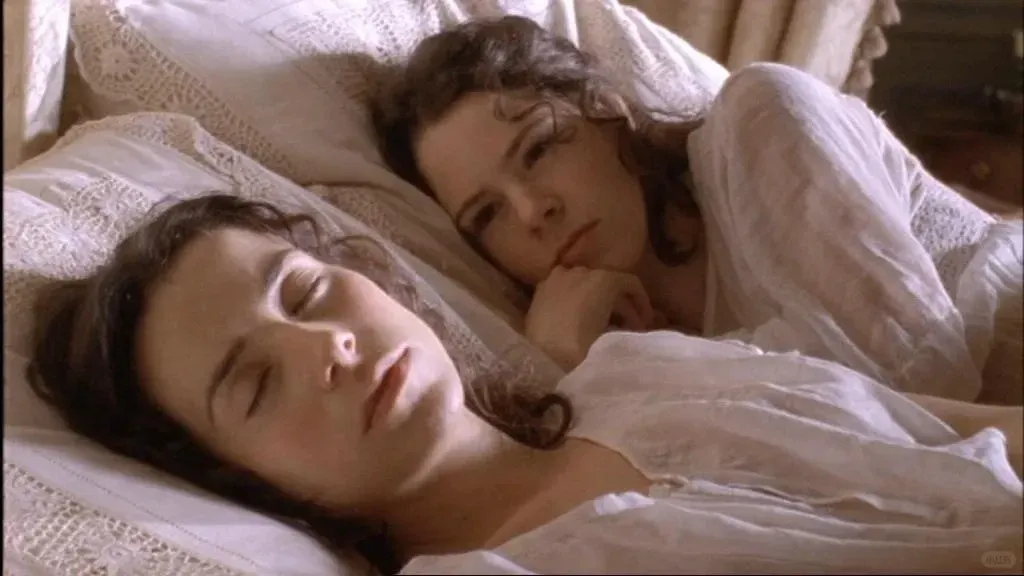
This BBC miniseries is adapted from Fingersmith, and it carries the weight of its author’s scholarship in every detail. Watching it again years later, I felt even more strongly that this is not just a love story. It’s a historical excavation of power, gender, and desire.
Fingersmith Official Trailer
Fingersmith Summary | |
|---|---|
| Title: | Fingersmith |
| Series Info: | UK (2005) |
| Length: | 60 minutes |
| Total Episodes: | 3 episodes |
| Genre: | Romance, Girl's love |
Plot
The story is set in Victorian England and follows Sue Trinder, a young woman raised among thieves in London’s slums. From the beginning, I saw the world through her eyes: sharp, physical, suspicious, streetwise.
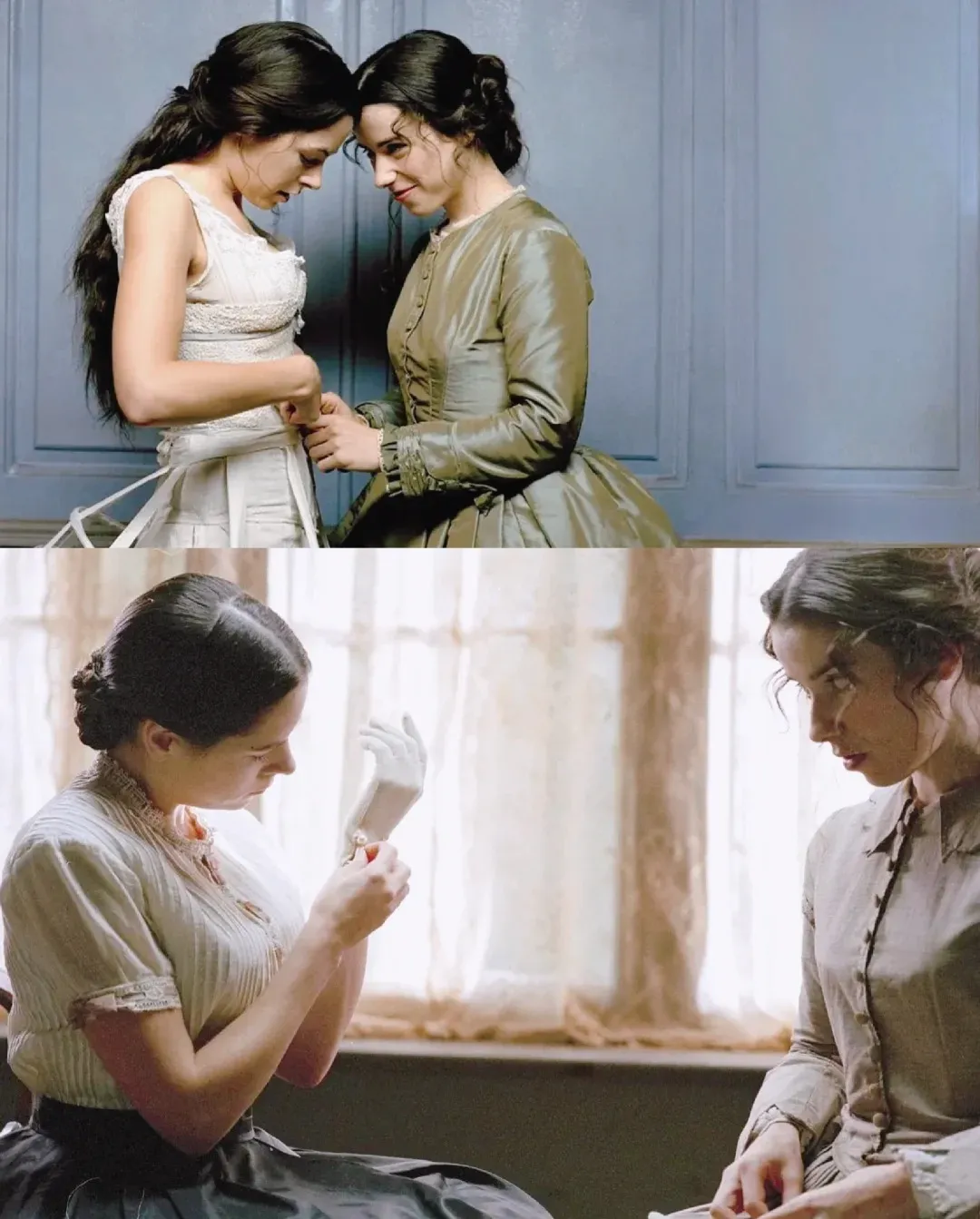
Sue is recruited into a plan to deceive Maud Lilly, a wealthy young woman living in isolation at Briar, a remote country estate. The scheme seems straightforward — seduce Maud into marriage, commit her to an asylum, and steal her fortune.
But the series refuses to stay simple.
Halfway through, the narrative rewinds and retells the same events from Maud’s perspective. Suddenly, everything I thought I understood collapses. The victim is no longer who I assumed. The power dynamics shift. Trust becomes impossible.
As a viewer, I was forced to admit how easily I had accepted the first version of events — and how complicit that made me.
Fingersmith Cast
Charactor

Sue is rough-edged, instinctive, and emotionally transparent. She comes from London’s underclass, speaks with her body, and reacts before she plans. What moved me most about Sue is not her toughness, but how easily her loyalty turns into vulnerability once real affection enters the picture.
Sally Hawkins
Sally Hawkins brings an extraordinary physicality to the role. Before becoming widely known for later arthouse and mainstream films, she was already demonstrating here her gift for emotional openness. Her Sue feels alive in every gesture — impulsive, sincere, and painfully human. Watching her, I never doubted the character’s capacity to love too much, too quickly.
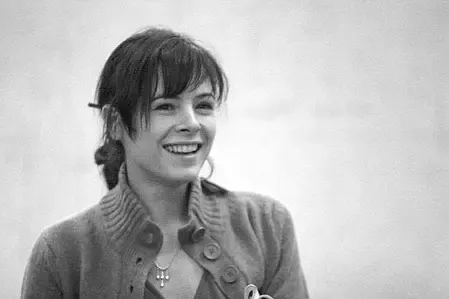
Maud appears restrained, almost bloodless at first — a young woman shaped by isolation, discipline, and intellectual labor. But beneath that stillness is calculation, resentment, and a hunger for agency that slowly surfaces.
Elaine Cassidy
Elaine Cassidy’s performance is what makes Maud unforgettable for me. She plays restraint not as emptiness, but as pressure. Every pause feels intentional; every softened look feels earned. I was especially struck by how her Maud never fully explains herself — she lets silence do the work, which makes her eventual emotional shifts far more unsettling.
Supporting Cast

Gentleman
Rupert Evans

Uncle Lilly
Charles Dance

Mrs Sucksby
Imelda Staunton
Fingersmith Review
Review
Why the Victorian World Feels So Disturbingly Real
One reason Fingersmith affected me so deeply is because it never feels decorative. The Victorian setting is not aesthetic wallpaper — it is an active force.
That’s where Sarah Waters matters.
She is a scholar of 19th-century queer literature, and it shows. While watching, I was struck by how meticulously the series depicts:
the underground publication and circulation of erotic texts
London’s slums as spaces of both brutality and vitality
mental asylums as tools of social control
women imprisoned not for illness, but for inconvenience
wives stripped of property, autonomy, and even clothing
These aren’t exaggerated horrors. They’re researched realities. Knowing that made every asylum scene feel heavier — not dramatic, but historical.
Fingers, Labor, and the Meaning of “Fingersmith”
The title fascinated me more the longer I watched.
In the 19th century, a fingersmith was a highly skilled pickpocket — someone gifted with their hands. Watching the series, I realized how quietly this idea structures the entire story.
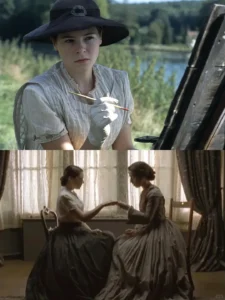
Maud’s fingers are protected by gloves. They are trained for transcription, for handling forbidden books, for serving male scholarship.
Sue’s fingers are trained for theft, for survival, for quick decisions made in hostile environments.
In different ways, both women are fingersmiths — shaped by class, discipline, and exploitation. That parallel stayed with me long after the final episode.
Desire Without Roles
What I love most about Fingersmith is how it refuses clear sexual roles.
At first, it seems easy: Maud is reserved, Sue is wild. But that reading doesn’t survive the series.
As the story unfolds, Maud’s sharpness, anger, and strategic cruelty surface, while Sue’s emotional vulnerability becomes increasingly exposed. Watching them together, I stopped trying to map “masculine” and “feminine” roles onto them at all.
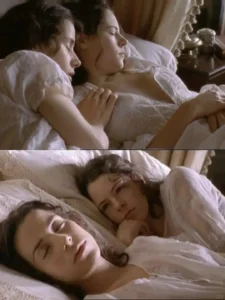
The series doesn’t ask me to decide who leads and who follows. It lets desire move back and forth, unevenly, unpredictably.
How the Series Handles Desire
There are no sensational scenes here — and that’s exactly why it works.
For me, the intimacy lives in:
Maud’s lingering, calculating gaze
the way she engineers closeness under polite excuses
the pauses before touch
the quiet request to be seen
the gradual shift from stillness to intention
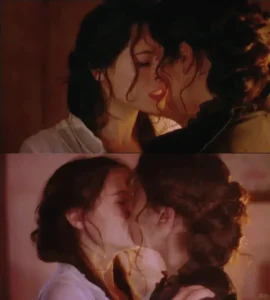
I found myself replaying scenes not for spectacle, but for micro-expressions — the searching, the hesitation, the restraint breaking just enough to reveal longing.
To me, this is where queer storytelling becomes powerful: not in fulfillment, but in the constant, aching search for connection.
Structure, Betrayal, and Female Complicity
Structurally, Fingersmith uses repeated narration to destabilize truth. Each version forces me to question the one before it.
What struck me most, though, is how the story ultimately shifts away from a simple “men exploit women” framework and toward something more complicated: women exploiting, protecting, betraying, and saving one another under patriarchy.
By the end, male authority feels hollow — almost buried — while the emotional center becomes female sacrifice, inheritance, and survival.
I’ll admit: I prefer the first half of the series. The raw tension between Sue and Maud, where love emerges inside deception, feels sharper and more dangerous. The later revelations are intellectually satisfying, but they slightly dilute the purity of that original emotional conflict.
My Take
Watching Fingersmith, I wasn’t moved because it offered a “beautiful” lesbian romance.
I was moved because it refused innocence.
It allows queer desire to exist alongside manipulation, fear, strategy, and compromise — without apologizing for any of it. It understands that, historically, love between women was never allowed to be simple.
That honesty is what makes Fingersmith endure for me — not as a period piece, but as a deeply queer act of remembrance.
Best Scenes of Fingersmith
1. The First Meeting — Maud Standing in the Light
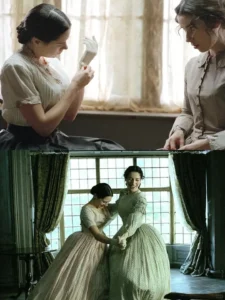
The first time Maud appears, standing quietly in a shaft of light while reading Sue’s forged recommendation letter, I already felt myself falling into the trap.
Even though I knew the plot, I still believed her.
Her voice is slightly hoarse, controlled, almost fragile. The way she stands — composed but oddly exposed — made her seem impossibly innocent. This scene works because it mirrors the viewer’s own vulnerability: I wanted to trust her, just as Sue does. That emotional misalignment is the foundation of everything that follows.
2. The Corset Scene — Intimacy as Discipline
The corset scene is one of the most famous moments in Fingersmith, but what struck me most is not the physical closeness — it’s the power structure.
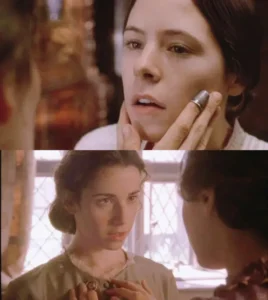
This is intimacy framed as routine, as care, as duty. Maud’s body is treated like an object that must be arranged correctly, while Sue’s hands become both servant’s tools and carriers of desire.
For me, this scene quietly establishes the series’ central tension: desire emerging inside systems that are not designed to allow it.
3. Reading the “Forbidden” Books Together
Any scene where Maud reads or handles the erotic texts stayed with me longer than expected.
What fascinated me wasn’t the content of the books, but Maud’s emotional distance while engaging with them — and how that distance shifts once Sue is present. Knowledge, shame, and curiosity intersect in a way that feels deeply Victorian and deeply queer at the same time.
Watching Maud repurpose something meant for male consumption into a private, emotionally charged space felt like an act of quiet resistance.
4. The Carriage to the Asylum — When the Ground Collapses
The moment Sue is dragged from the carriage and committed instead of Maud is one of the most devastating reversals I’ve seen in a period drama.
What made it unbearable for me wasn’t just the betrayal — it was the realization that the system works perfectly. No mistake is made. No authority is confused. The wrong woman is not taken by accident; she is taken because she is disposable.
This scene crystallizes the horror of Victorian institutions and turns the love story into something far darker and more political.
5. Maud Watching Sue — Desire Without Words
There are several quiet moments where Maud simply watches Sue — her back turned, her posture unguarded, her presence unperformative.
These moments are brief, almost throwaway, but they are where I felt Maud’s desire most clearly. Not acted upon, not declared — just observed, held, restrained.
As a queer viewer, I recognized that look immediately: the look of wanting something you are not allowed to name.
6. The Ending at Briar — Reclaiming a Ruined Space
The final scenes at Briar, after male authority has effectively collapsed, stayed with me as an image of emotional reclamation.
This house — once a site of confinement, surveillance, and exploitation — becomes something quieter, emptier, and finally negotiable. It’s not a fairy-tale ending. It’s a fragile truce with the past.
For me, this ending works because it doesn’t erase trauma. It simply allows space for something else to grow in its shadow.
Fingersmith Information
Where to Watch
🔒 Not available in your region?
Try using a VPN to access official platforms safely.
👉 We use NordVPN because it’s fast, stable for streaming, and works with most geo-restricted BL/GL titles.